Introduction – Why Real Estate SEO in 2026 Is No Longer Optional
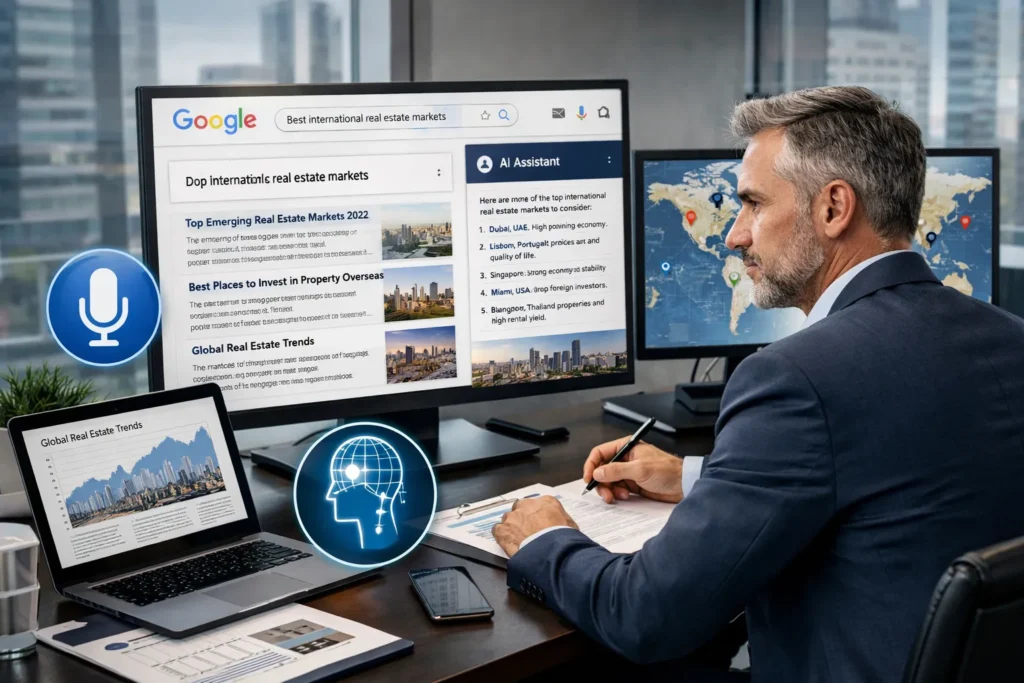
In 2026, real estate buyers don’t search the way they used to — they discover. According to recent industry data, over 70% of property-related journeys now start with organic search or AI-assisted recommendations, not paid ads or property portals alone. At the same time, Google’s Search Generative Experience (SGE), AI assistants, voice search, and map-based discovery are fundamentally reshaping how people find properties, agents, and developers.
This is why real estate SEO in 2026 is no longer optional. It’s no longer just about ranking on Google — it’s about Search Everywhere Optimization.
Today, your potential clients are:
- Asking AI tools which developer is best in Dubai or Lahore
- Using voice search to find “ready-to-move villas near me”
- Exploring Google Maps before visiting a project site
- Comparing brands across blogs, reviews, videos, and FAQs
If your real estate brand doesn’t consistently show up across these touchpoints, you’re invisible — no matter how good your inventory is.
SEO Is Now a Profit Lever, Not a Marketing Expense
For agents, brokers, and developers, SEO has evolved from a “long-term marketing tactic” into a direct revenue driver. Unlike paid ads (which stop the moment budgets pause), SEO builds compounding visibility, lowers cost per lead, and attracts high-intent buyers who are already researching, comparing, and ready to act.
At Nexfin Services, we see this shift daily while helping real estate brands across our Services portfolio — SEO-led clients consistently generate higher-quality leads compared to portal-only or ad-only strategies.
Why Regional SEO Matters More Than Ever
SEO strategies in 2026 must be region-specific, especially in real estate:
- UAE: Buyers are logic-driven, data-focused, and heavily influenced by online credibility, reviews, and structured information
- Saudi Arabia: Vision 2030 developments have created massive search demand around new cities, mixed-use projects, and off-plan investments
- Pakistan: Rising overseas investment and local demand make localized SEO (city and area pages) critical — especially in markets like Lahore
- Qatar & Bahrain: Bilingual (English + Arabic) and voice-driven searches dominate high-value property queries
A one-size-fits-all SEO approach simply doesn’t work anymore — especially for competitive markets.
What This Guide Will Help You Achieve
This complete guide will walk you through:
- Modern real estate SEO strategies for 2026
- Execution frameworks for agents, brokers, and developers
- Tools, timelines, and expectations
- How to future-proof your visibility across Google, AI, voice, and maps
If you’re serious about long-term growth, authority, and inbound leads, this guide is for you.
Bookmark this guide for future reference
Subscribe to Nexfin Services insights via our website to stay ahead of real estate marketing trends
Let’s dive in.
On This Page
What Is Real Estate SEO in 2026? (Foundations & Evolution)
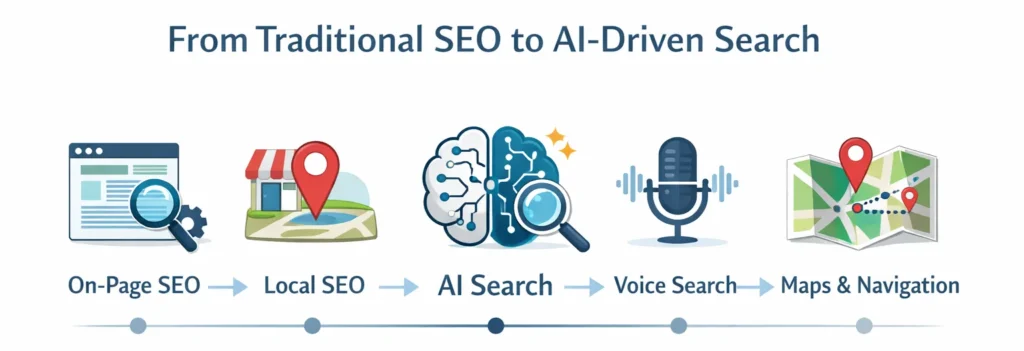
Real estate SEO in 2026 is no longer a single-channel strategy focused only on ranking web pages. It’s a multi-layered visibility system designed to place your brand in front of buyers, sellers, and investors wherever they research property decisions — across search engines, AI platforms, maps, and conversational interfaces.
Let’s break down what modern real estate SEO actually means today.
Definition of Modern Real Estate SEO
Modern real estate SEO is the strategic optimization of your digital presence to capture high-intent property searches across multiple discovery platforms. It combines:
- On-page SEO: Optimizing property pages, blogs, service pages, and FAQs with intent-based keywords and structured content
- Technical SEO: Site speed, Core Web Vitals, mobile UX, crawlability, and schema markup
- Local SEO: Google Business Profile optimization, location pages, and map visibility
- Off-page SEO: High-quality backlinks, digital PR, citations, and brand mentions
- AI SEO: Structuring content so it’s cited and referenced by AI-driven search experiences
In 2026, SEO is built around intent, not keywords alone:
- Buyer intent: “Luxury apartments in Dubai Marina with payment plan”
- Seller intent: “Best real estate agents in Lahore for home selling”
- Investor intent: “High ROI off-plan projects in Saudi Arabia Vision 2030”
Across regions like UAE, Saudi Arabia, Pakistan, Qatar, and Bahrain, these high-intent queries reflect serious commercial readiness — exactly where SEO delivers the highest ROI. This is why SEO sits at the core of our strategy offerings at Nexfin Services.
How Real Estate SEO Has Evolved Since 2024–2025
Between 2024 and 2026, SEO has undergone its biggest shift in over a decade.
The focus has moved:
- From ranking blue links → to being visible in AI-generated answers
- From “search results” → to conversational discovery
Google’s AI Overviews, along with platforms like ChatGPT and Perplexity, now summarize, recommend, and compare real estate options directly within the search experience. This has accelerated:
- Zero-click searches, where users get answers without visiting multiple sites
- Conversational queries, especially via voice and mobile
To stay competitive, real estate websites must now be:
- Structured for AI comprehension
- Rich in contextual data and local insights
- Supported by authoritative external signals
Google has publicly documented these changes through its evolving search guidelines and AI updates (Google Search Central), reinforcing the importance of high-quality, helpful content.
Why SEO Matters More Than Portals in 2026
Property portals like Bayut, Zameen, and PropertyFinder still play a role — but relying on them exclusively is risky.
Here’s why SEO outperforms portal dependency:
- Reduced dependency: You own your traffic, leads, and data
- Long-term ROI: SEO compounds, while PPC and portal leads get more expensive every year
- Brand authority: Your website becomes the source of trust — not just another listing
Agents and developers who invest in SEO build direct relationships with prospects, rather than renting visibility from third-party platforms. This shift is central to sustainable growth, something we emphasize across our About and Pricing discussions with clients.
E-E-A-T in Real Estate SEO (Non-Negotiable in 2026)
Google’s E-E-A-T framework (Experience, Expertise, Authority, Trust) is especially critical in real estate:
- Experience: First-hand local insights, community knowledge, regulations, and market realities
- Expertise: Data-backed guides, market reports, and educational content
- Authority: Earned backlinks, media mentions, and industry citations
- Trust: Transparent pricing, verified reviews, clear contact details, and compliance
Real estate decisions are high-stakes — and in 2026, only brands that demonstrate genuine credibility will win organic visibility.
Key Trends Shaping Real Estate SEO in 2026

Real estate SEO in 2026 is being shaped by how people consume information, not just how search engines crawl pages. Buyers, investors, and developers now expect instant answers, rich visuals, fast experiences, and credible insights — across multiple formats and platforms. Below are the most important trends redefining visibility and lead generation in real estate.
AI-Driven Search & Generative Engine Optimization (GEO)
AI-powered search experiences are now the default, not the exception. Google’s AI Overviews, along with tools like ChatGPT and Perplexity, summarize, recommend, and cite sources instead of showing long lists of links.
To stay visible, real estate brands must adopt Generative Engine Optimization (GEO):
- Structuring content for AI citations: Clear headings, concise explanations, and fact-backed sections increase the likelihood of being referenced by AI answers
- Entity-based optimization: Strong signals around locations, developers, project names, and property types help AI systems understand who you are and what you represent
- Agent-ready content formats: Comparison tables, FAQs, step-by-step guides, and location explainers perform exceptionally well in AI-driven discovery
Google has highlighted the importance of structured, helpful content in its AI search documentation (Google Search Central), reinforcing this shift.
Voice Search & Conversational Queries
Voice search continues to grow rapidly, especially in mobile-first and bilingual markets like UAE, Saudi Arabia, Qatar, and Bahrain. Buyers are increasingly using natural speech to ask:
- “What are the best investment areas in Dubai right now?”
- “Ready to move apartments near me”
- Arabic and English mixed queries in GCC markets
To optimize for voice:
- Focus on natural-language FAQs
- Use conversational phrasing instead of rigid keyword stuffing
- Create short, direct answers that work well for voice assistants
This is why an optimized FAQs page is no longer optional — it’s a core SEO asset for real estate websites in 2026.
Video, Visual & Multimodal Search
Search is no longer text-only. Buyers want to see before they visit.
Key visual SEO drivers include:
- YouTube property walkthroughs and market explainers
- Short-form video for social discovery and SERP visibility
- Drone shots, 3D tours, and virtual walkthroughs for premium listings
From an SEO perspective:
- Image and video schema help search engines understand and feature your visuals
- Optimized video descriptions and thumbnails increase visibility across Google and YouTube
Visual content also strengthens trust — a critical factor for high-value decisions. This approach aligns closely with the conversion-focused strategies we implement through our Services at Nexfin Services.
Mobile-First & Core Web Vitals
In 2026, over 80% of real estate searches happen on mobile devices, making mobile-first optimization non-negotiable.
Google now treats user experience (UX) as a direct ranking signal:
- Fast loading times
- Smooth interactions
- Clean, intuitive navigation
Poor mobile UX doesn’t just hurt rankings — it kills conversions. Real estate websites must prioritize Core Web Vitals to remain competitive, especially for location-based searches and Google Maps visibility.
Zero-Click SEO & Featured Snippets
Zero-click searches are increasing, but they’re not the enemy — they’re an opportunity.
Winning strategies include:
- Answer-first content that delivers immediate value
- Snippet-friendly formatting (bullet points, tables, short paragraphs)
- Clear definitions and comparisons
Featured snippets and AI summaries position your brand as the default authority, even when users don’t click immediately. This authority compounds over time and supports long-term trust building.
Sustainability & Smart Communities as SEO Signals
Sustainability is no longer just a sales angle — it’s a search behavior trend.
In markets like UAE and Saudi Arabia, users actively search for:
- Eco-friendly developments
- Smart communities
- Energy-efficient and future-ready projects
Search engines increasingly associate these themes with quality and relevance. Highlighting sustainability features, certifications, and smart infrastructure within your content improves both SEO performance and buyer trust.
Keyword Research for Real Estate SEO (High-Intent Only)
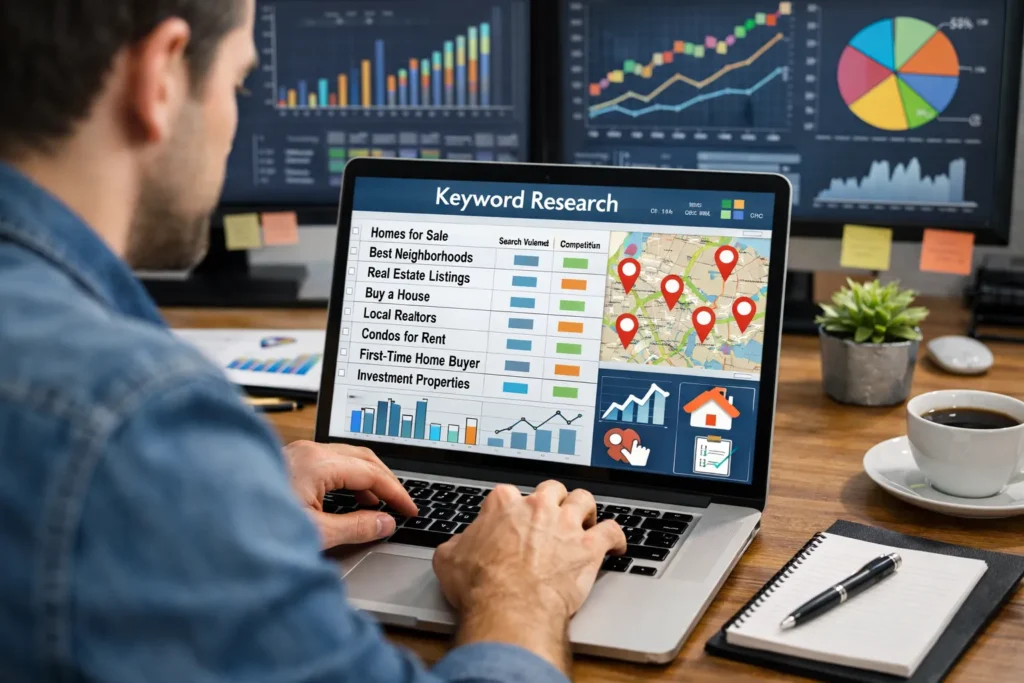
In 2026, keyword research for real estate SEO is no longer about chasing volume — it’s about capturing intent. High rankings mean nothing if the traffic doesn’t convert. Successful real estate brands focus on keywords that indicate readiness to buy, sell, invest, or inquire.
This section breaks down how to identify and prioritize high-intent keywords that actually generate leads.
Understanding Search Intent in Real Estate
Every real estate search falls into one of four intent categories. The key is knowing which ones make money.
- Transactional intent:
These searches indicate immediate action.- “Buy apartment in Dubai Marina”
- “Off-plan villas Saudi Arabia payment plan”
- “Property dealers in Lahore DHA”
- Informational intent:
Research-driven but high-value when nurtured.- “Best areas to invest in Qatar real estate”
- “Property buying process in UAE for expats”
- Navigational intent:
Brand- or platform-focused queries.- Developer names, project names, or agency searches
- Local & hyper-local intent:
The most valuable for agents and brokers.- “Real estate agent near me”
- “Flats for sale in Bahria Town Lahore”
A balanced SEO strategy attracts users across the funnel — something we architect carefully through our Services at Nexfin Services.
Hyper-Local & Neighborhood-Level Keywords
High-performing real estate SEO in 2026 is built from the ground up:
City → Area → Community → Project
Examples across regions:
- UAE:
- Dubai → Dubai Marina → Marina Gate → Marina Gate apartments for sale
- Saudi Arabia:
- Riyadh → North Riyadh → Al Malqa → villas for sale in Al Malqa
- Pakistan:
- Lahore → DHA → Phase 6 → DHA Phase 6 houses for sale
- Qatar:
- Doha → The Pearl → Porto Arabia → apartments for sale in The Pearl
- Bahrain:
- Manama → Seef District → Seef residences for sale
These hyper-local keywords convert exceptionally well because they match on-ground buyer behavior. This is also where location pages (like your Lahore page under Locations) become powerful SEO assets.
Multilingual & Arabic Keyword Strategy
In GCC markets, language reflects intent.
Key differences:
- English searches: Often used by investors, expats, and overseas buyers
- Arabic searches: Frequently indicate local buyers with higher intent and faster decision cycles
Best practices:
- Use bilingual pages when search intent overlaps and content is similar
- Use separate URLs when intent, terminology, or regulations differ significantly
Avoid direct translation — Arabic keywords often follow conversational or culturally specific phrasing. Google’s multilingual SEO guidelines emphasize intent alignment over literal translation (Google Search Central).
Tools & Keyword Research Process
Effective keyword research in 2026 blends data with strategy:
- Ahrefs & Semrush:
Identify long-tail opportunities, keyword difficulty, and competitor gaps - Google Search Console (GSC):
Discover real queries already triggering impressions
Critical rule:
Avoid ultra-competitive, portal-dominated keywords where Bayut, Zameen, or PropertyFinder control the SERPs. Instead, target:
- Long-tail phrases
- Local modifiers
- Informational + transactional hybrids
This approach reduces competition and improves ROI — a key reason many agencies fail at real estate SEO.
Sample High-Intent Keyword Buckets
Here’s how keywords should be grouped by audience:
- Agents:
- “Real estate agent in Dubai Marina”
- “Property dealer near me Lahore”
- Brokers:
- “Commercial real estate broker Riyadh”
- “Luxury property broker UAE”
- Developers:
- “Off-plan real estate marketing UAE”
- “Property development projects Saudi Arabia”
- Investors:
- “Best real estate investment in Qatar”
- “High ROI property in Pakistan”
Keyword research done right sets the foundation for everything else — content, pages, and conversions.
Content Strategy That Builds Authority & Converts
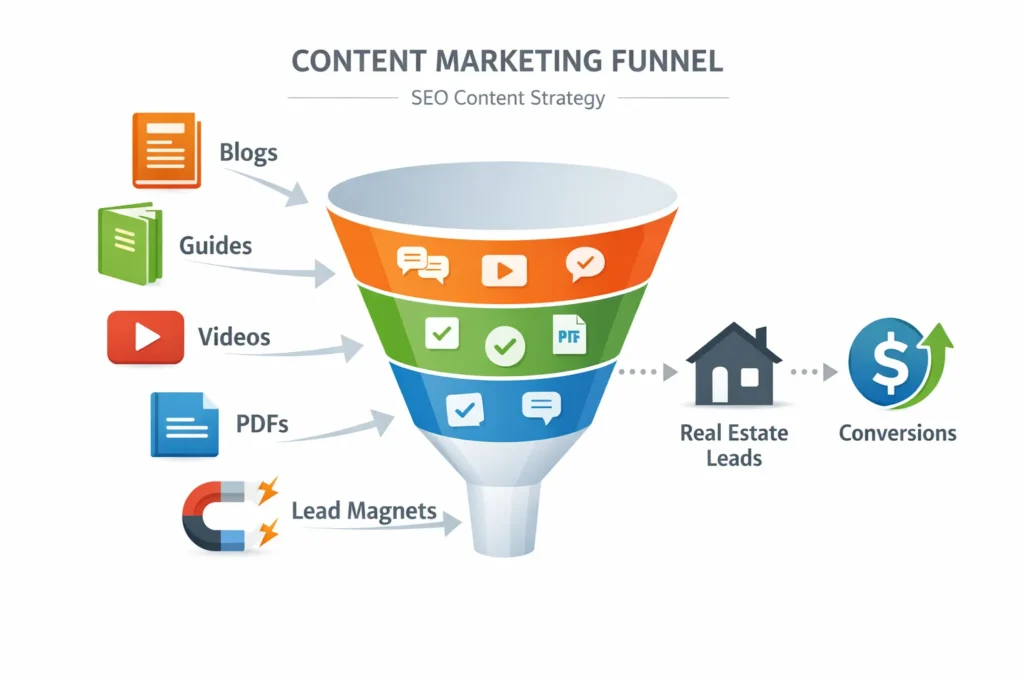
In 2026, content is no longer about publishing frequently — it’s about owning conversations. For real estate brands, the right content strategy positions you as the trusted authority while quietly guiding buyers, sellers, and investors toward conversion.
The goal is simple: educate first, convert second.
Pillar Pages & Topic Clusters (The SEO Backbone)
Authority in real estate SEO is built through pillar pages supported by tightly linked topic clusters. A pillar page covers a broad, high-intent topic, while clusters dive into specific subtopics.
High-performing examples include:
- “Buying Property in Dubai”
- Subtopics: legal process, costs, best areas, off-plan vs ready
- “Real Estate Investment in Saudi Arabia”
- Subtopics: Vision 2030, ROI cities, foreign ownership rules
Each pillar page:
- Targets a primary commercial keyword
- Internally links to cluster articles
- Acts as a long-term traffic and lead hub
Internal linking is critical. Blog posts should naturally link back to:
- Services (to show how expertise is implemented)
- Locations (for local relevance)
- Contact and Pricing pages (for conversion intent)
This structure ensures both search engines and users understand your authority — something we emphasize heavily in Nexfin Services’ SEO frameworks.
Buyer-Focused Content Types That Convert
Not all content converts equally. In real estate, decision-support content outperforms promotional content by a wide margin.
High-impact formats include:
- Blogs & in-depth guides:
Educational, intent-driven, and ideal for organic discovery - Market reports:
Quarterly or annual insights that attract investors and media mentions - Comparison pages:
“Area A vs Area B”, “Off-plan vs Ready Property” — excellent for mid-funnel buyers - Investment calculators:
ROI, rental yield, and affordability calculators boost engagement and trust - Area & lifestyle guides:
Schools, connectivity, amenities, and community vibes — especially effective for relocation buyers
These content types also strengthen E-E-A-T, which directly impacts rankings in competitive real estate niches.
AI + Human Content Workflow (The Winning Formula)
AI has changed how content is created — but not who should be trusted.
The most effective workflow in 2026 combines:
- AI for research & structure:
Topic ideation, outline creation, and SERP analysis - Human expertise for insights & trust:
Local market knowledge, regulations, pricing realities, and lived experience
Search engines increasingly detect and reward content that reflects real-world experience, not generic summaries. That’s why purely AI-written content struggles to rank long-term.
To stay competitive:
- Refresh key pages quarterly
- Update stats, pricing ranges, and regulations
- Improve internal links as new content is added
This ongoing refinement is what separates authority sites from content farms.
Lead Magnets & Conversion Assets (Where SEO Turns Into Revenue)
Traffic without conversion is wasted potential. High-performing real estate SEO always includes lead capture assets.
Effective lead magnets include:
- Checklists:
“Property Buying Checklist for UAE Expats” - Downloadable PDFs:
Investment guides, buyer handbooks, or seller playbooks - Market snapshots:
Short, data-driven insights for specific cities or communities
For conversion:
- Integrate WhatsApp click-to-chat for instant inquiries
- Use short, frictionless lead forms
- Clearly link to your Contact and Pricing pages for serious prospects
These assets transform informational traffic into qualified leads — and position your brand as helpful, not salesy.
A well-executed content strategy compounds over time.
On-Page SEO for Real Estate Websites
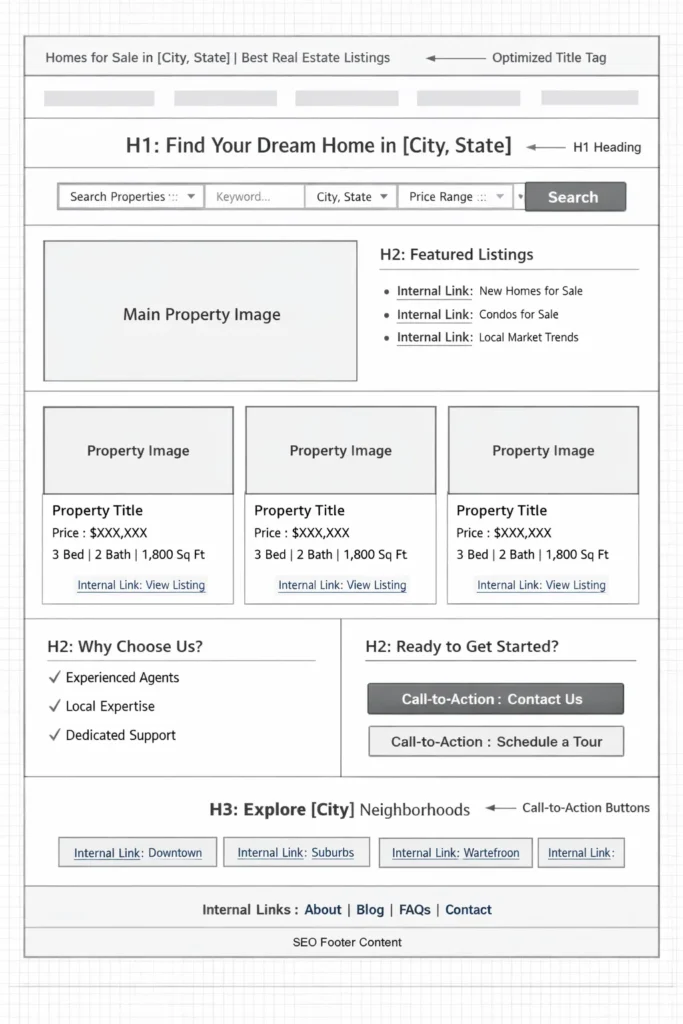
In 2026, on-page SEO is where strategy meets execution. Even the best keyword research and content planning will fail if your pages aren’t optimized for both search engines and users. For real estate websites, on-page SEO must balance discoverability, clarity, and conversion flow.
Core On-Page Elements (Non-Negotiables)
Strong on-page optimization starts with fundamentals — but they must be executed with intent.
- Title tags & meta descriptions:
Every page should clearly communicate value and intent.- Include primary keyword + location modifier
- Keep titles under ~60 characters and descriptions under ~155 characters
- Focus on click-worthiness, not keyword stuffing
- Header hierarchy (H1–H3):
- One clear H1 per page
- Logical H2 and H3 sections for scannability
- Use headers to reflect search intent, not just design
- SEO-friendly URLs:
- Short, descriptive, and readable
- Avoid numbers, dates, or unnecessary parameters
- Example:
/real-estate-seo-dubaiinstead of/page?id=123
These elements help search engines understand your page structure while improving user experience — a priority emphasized across Google’s on-page SEO guidelines (Google Search Central).
Image & Media Optimization (Critical for Property SEO)
Real estate is a visual-first industry, but unoptimized media can slow your site and hurt rankings.
Best practices include:
- Alt text:
Describe images accurately with natural keywords (e.g., “luxury apartment in Dubai Marina”) - File naming:
Use descriptive filenames instead of generic ones (dubai-marina-apartment.jpg) - Lazy loading:
Load images only when needed to improve page speed and Core Web Vitals
Optimized images improve:
- Page speed
- Accessibility
- Visibility in image-based search results
This is especially important for listing pages, area guides, and blog posts.
Internal Linking & UX Flow
Internal linking is one of the most underutilized SEO levers in real estate.
An effective structure follows a natural discovery path:
Property → Area → City → Blog
For example:
- A property page links to its area guide
- The area guide links to the city page
- The city page links to educational blog content
This structure:
- Distributes link equity efficiently
- Improves crawlability
- Keeps users engaged longer
Just as importantly, internal links should support conversion paths:
- Educational pages → Services
- High-intent pages → Contact or Pricing
- Informational blogs → FAQs for trust building
This approach aligns SEO with business goals — not just traffic metrics.
Schema Markup for Real Estate (Visibility Multiplier)
Schema markup helps search engines understand your content, not just read it. In 2026, schema is essential for enhanced SERP features and AI-driven visibility.
Key schema types for real estate include:
- RealEstateListing schema:
Property details like price, location, availability - LocalBusiness schema:
Agency information, address, service areas - FAQ schema:
Increases chances of rich results and voice answers - Video schema:
Improves visibility of walkthroughs and virtual tours - Person schema:
Highlights agents, brokers, and leadership profiles
Correct implementation improves eligibility for:
- Rich snippets
- AI summaries
- Voice search results
Schema isn’t optional anymore — it’s a competitive advantage.
On-page SEO creates the foundation for rankings, but it must be supported by technical SEO to perform at scale.
Technical SEO – Your Website’s Backbone

In 2026, technical SEO is the foundation that ensures all your content, keywords, and on-page optimizations actually work. For real estate websites, technical excellence isn’t optional — slow, unstructured, or poorly indexed sites lose both rankings and high-intent leads.
Core Technical Foundations
Every real estate website must start with rock-solid basics:
- Site speed:
Buyers expect instant results. Optimizing images, compressing code, and leveraging CDNs keeps property pages fast — a ranking factor and UX necessity. - Mobile responsiveness:
With over 80% of searches happening on mobile devices in GCC and Pakistan, responsive design ensures all visitors can browse listings, guides, and forms seamlessly. - HTTPS & security:
SSL encryption builds trust and protects sensitive client data — a must for forms, calculators, and client portals. - Crawlability & indexation:
Proper URL structure, sitemap submission, and internal linking ensure search engines can discover and index all key pages efficiently.
Advanced Technical SEO
Beyond the basics, advanced optimizations separate high-performing real estate sites from the rest:
- Core Web Vitals:
Google prioritizes metrics like Largest Contentful Paint (LCP), First Input Delay (FID), and Cumulative Layout Shift (CLS). These directly influence rankings and user engagement. - Canonicals & index bloat:
Avoid duplicate content issues by setting canonical tags on property pages and preventing low-value pages from being indexed. - XML sitemaps & robots.txt:
Keep search engines aware of your important pages while restricting irrelevant or temporary URLs. Regularly update sitemaps to include new listings, blogs, and location pages.
Domain & Hosting Considerations
For international real estate targeting across UAE, Saudi Arabia, Pakistan, Qatar, and Bahrain, your domain strategy matters:
- ccTLDs (country-code domains):
Examples:.aefor UAE,.safor Saudi Arabia,.pkfor Pakistan. ccTLDs signal strong local relevance for search engines. - International targeting:
Use hreflang tags for multilingual content and separate URLs when English and Arabic pages serve distinct user intent. - Hosting:
Fast, reliable hosting close to your primary audience reduces latency, improves Core Web Vitals, and supports AI-driven search indexing.
Technical SEO ensures your real estate website is search-engine ready, fast, and user-friendly. Without it, even the best content strategy will struggle to convert.
Local SEO – Dominating Cities, Areas & Communities
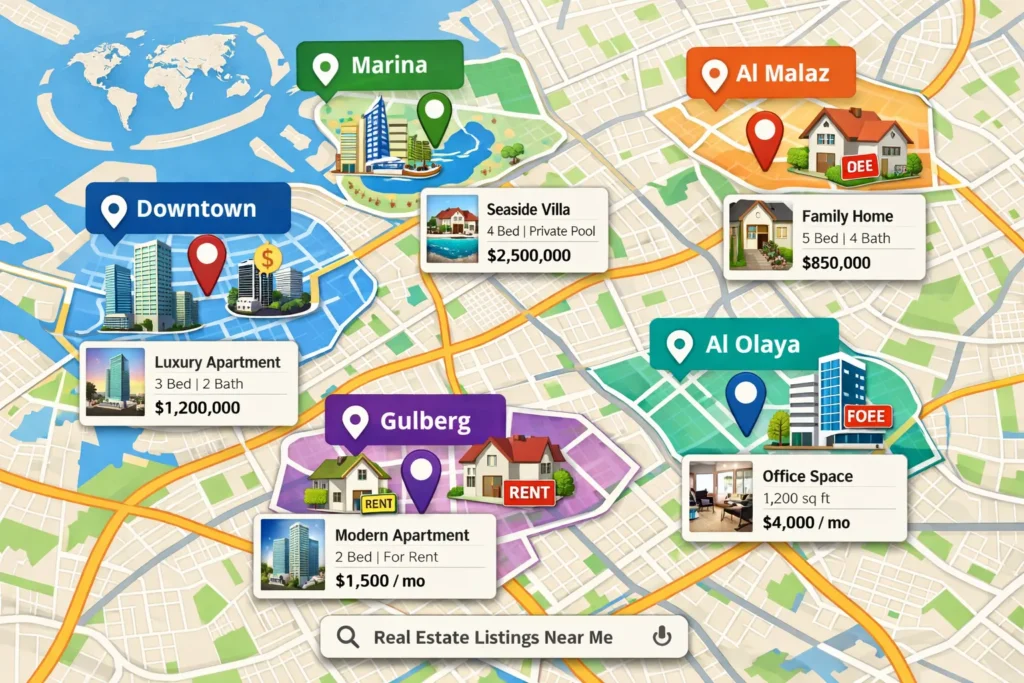
In 2026, local SEO is the single most effective way for real estate agents, brokers, and developers to capture high-intent leads. Buyers are no longer scrolling endless portals; they are searching for properties and services right in their city, neighborhood, or community. Local SEO ensures your brand appears in front of the right prospects at the exact moment they’re ready to act.
Google Business Profile Optimization
A fully optimized Google Business Profile (GBP) is the cornerstone of local real estate visibility. Key elements include:
- Categories:
Choose precise categories such as “Real Estate Agency,” “Property Developer,” or “Real Estate Broker” to align with search intent. - Services:
List all services clearly — off-plan sales, investment consulting, property management, etc. - Photos & Posts:
Regularly upload high-quality property images, project walkthroughs, and short updates. Visual content increases clicks and engagement. - Reviews Strategy:
Encourage satisfied clients to leave reviews. Respond promptly to both positive and negative feedback to build trust and improve local rankings.
An optimized GBP improves visibility across Google Maps, local packs, and AI-driven discovery platforms.
Hyper-Local Pages That Rank
Hyper-local content is critical for capturing niche search intent. Structure pages as:
- City pages:
“Real Estate in Dubai” or “Lahore Property Listings” target city-level searches and act as hubs for neighborhoods. - Neighborhood pages:
“DHA Phase 6 Homes for Sale” or “JVC Apartments” target buyers looking for specific communities. - Comparison content:
“DHA Phase 6 vs Phase 5” or “JVC vs Dubai Marina Apartments” helps prospects make informed decisions while keeping them on your site longer.
This layered structure improves crawlability, internal linking, and user experience — essential for capturing both buyer and investor attention.
Local Citations & Directories
Beyond Google, real estate authority is built through relevant citations:
- Property portals:
Bayut, Zameen, and PropertyFinder remain important for referral traffic and backlinks. - Chamber & business listings:
Local business directories, chambers of commerce, and real estate associations enhance credibility and local relevance. - Consistency:
Ensure NAP (Name, Address, Phone) consistency across all citations to avoid ranking penalties.
Region-Specific Local SEO Tactics
Each market has unique patterns that require tailored strategies:
- UAE:
Focus on high-demand micro-locations like Dubai Marina, DIFC, and Jumeirah Village Circle (JVC). Include both English and Arabic content. - Saudi Arabia:
Target Vision 2030 development hubs such as NEOM, King Abdullah Economic City, and urban expansion zones. Emphasize investment potential and regulations. - Pakistan:
Concentrate on major corridors and cities — Lahore, Karachi, and Bahria Town developments. Highlight hyper-local amenities, schools, and lifestyle factors. - Qatar & Bahrain:
Optimize for bilingual searches and voice queries. Include Arabic titles, FAQs, and natural-language long-tail keywords for premium property searches.
Local SEO in 2026 isn’t just about appearing on a map — it’s about owning visibility across cities, neighborhoods, and communities while converting searchers into qualified leads. Properly executed, it complements content, technical SEO, and on-page optimization to create a complete real estate SEO ecosystem.
Off-Page SEO & Authority Building

Off-page SEO in 2026 is about establishing credibility, trust, and authority for your real estate brand across the web. Search engines increasingly prioritize signals that demonstrate expertise, relevance, and popularity — beyond what happens on your site. For agents, brokers, and developers, this is where your reputation directly impacts rankings and lead quality.
Link Building That Works in 2026
High-quality backlinks remain a cornerstone of authority, but the approach has evolved:
- Local partnerships:
Collaborate with complementary businesses like mortgage brokers, interior designers, or local lifestyle blogs. These partnerships generate relevant, high-authority links while boosting local relevance. - PR & news mentions:
Featured articles in reputable outlets or real estate publications enhance credibility. Press coverage signals authority to both users and search engines. - Guest posting:
Contributing insights, market reports, or investment advice to established property or finance blogs can drive traffic, build your brand, and earn authoritative backlinks.
The focus should always be on quality over quantity. One authoritative link from a relevant source outweighs dozens of low-quality links.
Social Signals & Content Distribution
While social media links may not directly boost rankings, they amplify reach and brand authority, which indirectly affects SEO:
- Share content on Instagram, TikTok, YouTube Shorts, and LinkedIn to attract organic mentions
- Encourage brand searches and discussions online; search engines pick up signals of relevance and engagement
- Repurpose blogs, guides, and videos across platforms to increase backlinks and referral traffic
A strong social presence reinforces E-E-A-T (Experience, Expertise, Authority, Trust) and drives high-intent leads to your website.
What to Avoid
In 2026, some off-page practices can harm your SEO:
- Spam links: Low-quality, irrelevant links can trigger penalties
- Paid networks: Purchased backlinks rarely deliver value and often violate Google’s guidelines
- Irrelevant directories: Submitting to generic or unrelated directories dilutes authority rather than enhancing it
Focus on earned, contextual, and local relevance links. This approach ensures long-term authority and positions your real estate brand as a trusted market leader.
Properly executed off-page SEO, combined with content, on-page, technical, and local SEO strategies, completes the full-cycle approach needed to dominate real estate search visibility in 2026.
AI Integration & Future-Proofing Your Real Estate SEO

As we move deeper into 2026, AI is no longer optional in real estate SEO — it’s foundational. From lead generation to search visibility, integrating AI ensures your strategy adapts to evolving buyer behaviors and emerging technologies.
AI Chatbots for Lead Qualification
Modern buyers expect instant responses. AI-powered chatbots on property websites and landing pages can:
- Qualify leads automatically by asking key questions about budget, location, and property type
- Schedule viewings or connect prospects directly to agents via WhatsApp or CRM integrations
- Provide instant answers to common queries, reducing bounce rates and improving user experience
Chatbots combine conversational UX with actionable data, giving your team high-intent leads while maintaining 24/7 engagement.
Answer Engine Optimization (AEO)
Search is shifting from traditional keyword-based results to answer-driven AI experiences. Answer Engine Optimization (AEO) focuses on:
- Structuring content to be directly cited by AI
- Using FAQ sections, tables, and concise data points for AI comprehension
- Targeting entity-based search, where AI understands the relationship between developers, projects, and locations
AEO positions your content to appear in AI summaries, voice assistants, and zero-click results, extending your visibility beyond conventional SERPs.
Preparing for Predictive & Agent-Based Search
The future of real estate search includes predictive and agent-assisted discovery:
- Predictive search anticipates buyer intent based on past behavior, location, and investment patterns
- Agent-based platforms allow AI to recommend properties, brokers, and investment options to users before they even actively search
SEO strategies must feed these systems with structured, reliable, and up-to-date property data, including availability, pricing, and community insights. Real-time updates and property feeds are becoming essential.
Upcoming Tech Trends (6G, Smart Cities)
Emerging technologies will further transform real estate discovery:
- 6G connectivity will make real-time virtual tours, AR property visualizations, and AI-assisted searches seamless
- Smart cities in UAE and Saudi Arabia will generate hyper-local search demand based on community features, amenities, and sustainable infrastructure
Brands that integrate AI-driven SEO now are better positioned to capitalize on these technologies, ensuring long-term visibility, authority, and high-intent lead generation.
By adopting AI, AEO, and forward-looking strategies, real estate agencies, brokers, and developers can future-proof their SEO. This ensures your website doesn’t just compete in 2026 but leads the market in discovery, engagement, and conversions.
Essential SEO Tools for Real Estate in 2026
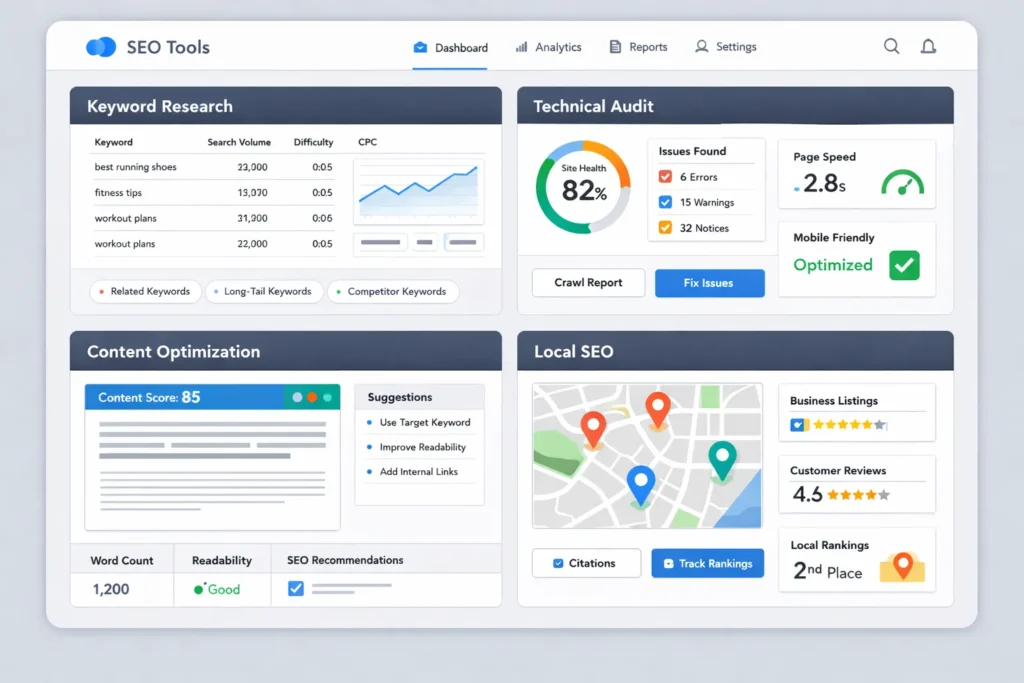
A successful real estate SEO strategy in 2026 relies on the right mix of tools to research, optimize, and track performance across multiple markets. Choosing tools that cover keywords, technical health, local visibility, and content quality ensures your efforts generate measurable results.
Keyword Research Tools
High-intent keyword discovery is critical. Use tools like Ahrefs, Semrush, and Google Keyword Planner to identify transactional, informational, and hyper-local search opportunities. These platforms help uncover long-tail keywords, competitor gaps, and search volume trends tailored for UAE, Saudi Arabia, Pakistan, Qatar, and Bahrain.
Technical Audit Tools
Your website’s performance underpins SEO success. Tools like Screaming Frog, Sitebulb, and Google Search Console allow you to audit crawlability, indexation, Core Web Vitals, and mobile responsiveness. They also detect duplicate content, broken links, and canonical issues to prevent ranking penalties.
Local SEO Tools
For region-specific strategies, tools like Moz Local, BrightLocal, and Google Business Profile Insights track rankings, reviews, and citation consistency. These help optimize city, neighborhood, and community pages while ensuring local visibility across Google Maps and voice search.
Content Optimization Tools
Creating content that converts requires insights on readability, relevance, and semantic depth. Tools like SurferSEO, Clearscope, and Grammarly analyze keyword usage, structure, and E-E-A-T alignment, ensuring your blogs, guides, and area pages meet modern search expectations.
Free vs Paid Tools
Many free tools, such as Google Search Console, Google Analytics, and Ubersuggest, offer essential insights, especially for small-scale projects. Paid tools like Ahrefs, Semrush, and SurferSEO provide advanced analytics, competitive research, and automation capabilities that scale for agencies managing multiple regions and high-intent properties.
Using the right combination of free and paid tools allows real estate professionals to save time, reduce errors, and make data-driven SEO decisions — the key to dominating the 2026 market.
Measuring SEO Success – KPIs, ROI & Timelines
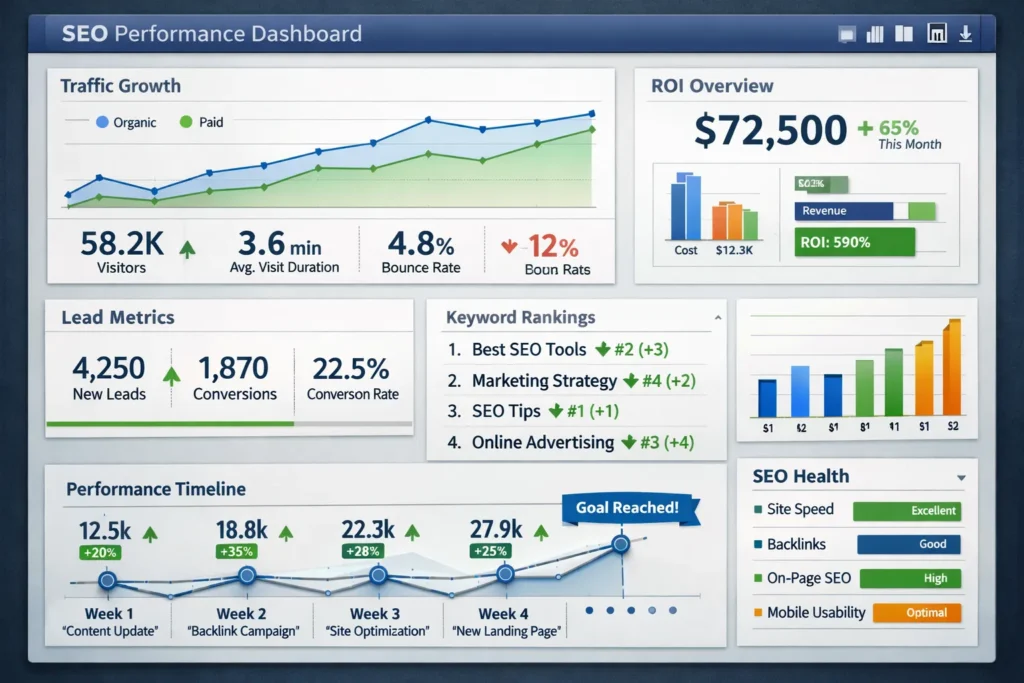
In 2026, real estate SEO isn’t just about rankings — it’s about measurable impact on traffic, leads, and revenue. Tracking the right KPIs allows agents, brokers, and developers to understand performance, optimize strategies, and forecast ROI.
Key Metrics That Matter
- Organic traffic:
Monitor growth in visits from search engines, focusing on high-intent pages like property listings, city/area pages, and investment guides. - Rankings:
Track visibility for target keywords across regions (UAE, Saudi Arabia, Pakistan, Qatar, Bahrain). Use SERP tracking tools to measure movement for both city-level and hyper-local queries. - Local pack visibility:
Monitor Google Business Profile impressions, map rankings, and review growth to ensure your agency or listings dominate local search. - Leads & conversions:
High-intent traffic must translate into actions. Track form submissions, WhatsApp clicks, downloads of PDFs, and calls to assess ROI. - Engagement metrics:
Time on page, bounce rate, scroll depth, and video interactions reflect content relevance and user satisfaction — crucial for long-term authority.
Realistic Timelines for Real Estate SEO
SEO is a long-term investment, and timelines vary depending on market competitiveness, content depth, and technical readiness:
- 3–6 months: Foundations
- Keyword research, on-page optimization, technical SEO fixes
- Launch of pillar pages, hyper-local pages, and Google Business Profile optimization
- 6–12 months: Authority & Growth
- Expansion of content clusters, backlink acquisition, and local citations
- AI-driven optimization, video and visual content scaling
- Measurable increases in leads, conversions, and regional dominance
Patience, consistent execution, and iterative improvement are essential. Combining data-driven insights with strategic adjustments ensures your real estate SEO investment delivers sustainable ROI and positions your brand as a market leader in 2026.
Real Estate SEO Case Scenarios (Regional Examples)
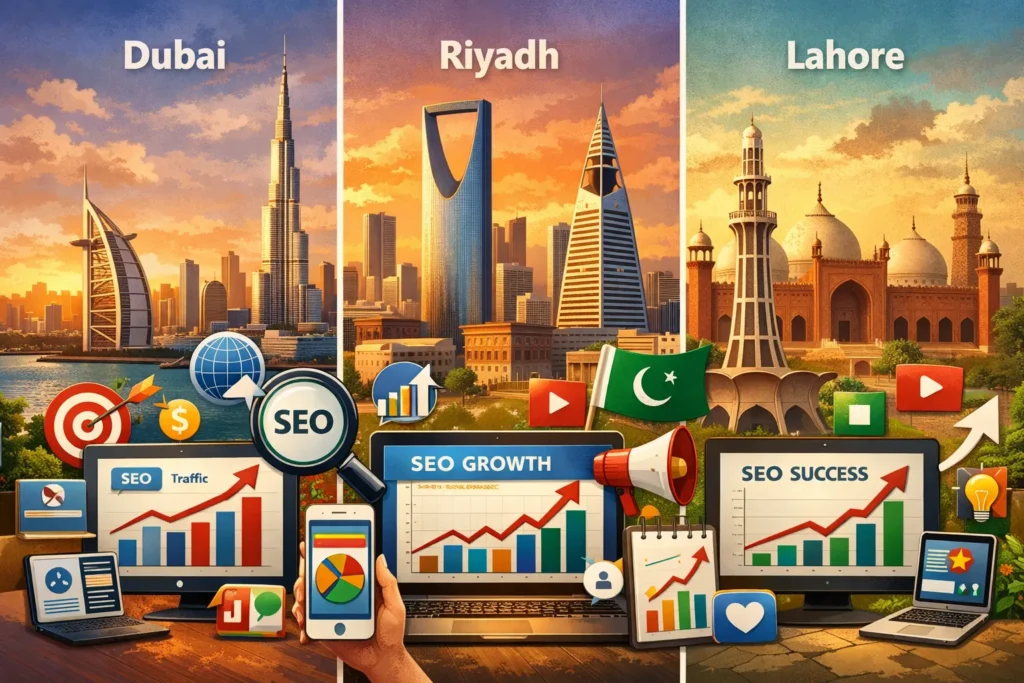
Understanding real-world applications of real estate SEO helps agents, brokers, and developers visualize how strategies translate into leads and conversions. Here are three regional case scenarios demonstrating best practices and lessons learned.
Developer in Dubai
A premium developer in Dubai wanted to increase off-plan apartment sales in Dubai Marina and Jumeirah Village Circle (JVC). By implementing a pillar page strategy with topic clusters like “Buying Property in Dubai Marina” and “JVC Off-Plan Investment Guide,” the developer:
- Optimized for AI and voice search queries
- Created neighborhood pages with detailed amenities and lifestyle insights
- Integrated AI chatbots to qualify leads and schedule viewings
Results: Within 9 months, organic traffic increased by 75%, with 60% of leads coming directly through the website rather than property portals.
Lesson learned: Hyper-local, intent-focused content combined with AI-driven user engagement drives higher-quality leads than relying solely on paid ads or portals.
Broker in Saudi Arabia
A commercial real estate broker targeting Vision 2030 urban hubs in Riyadh and Jeddah faced intense competition on generic keywords. The strategy focused on:
- Hyper-local SEO for emerging neighborhoods
- Arabic + English content targeting both local and expat investors
- PR-driven backlinks and guest posts on finance and investment publications
Results: Featured snippets and local pack placements increased, with a 50% improvement in inbound client inquiries from organic search.
Lesson learned: Bilingual content and authoritative backlinks are critical in GCC markets, where both local buyers and international investors drive demand.
Agent in Pakistan
An individual agent in Lahore wanted to dominate residential property searches in DHA and Bahria Town. Their approach included:
- Optimized Google Business Profile with complete NAP, photos, and reviews
- City → neighborhood → project pages linking to blogs and investment guides
- Lead magnets like downloadable property checklists and market snapshots
Results: Within 6 months, the agent’s website consistently appeared in local pack searches and generated direct inquiries that bypassed property portals, significantly increasing ROI.
Lesson learned: Local SEO, structured internal linking, and actionable lead magnets can level the playing field for individual agents in highly competitive markets.
Key Takeaways
Across all regions, success factors are consistent:
- Hyper-local content and city/neighborhood targeting
- Bilingual and AI-ready content in GCC markets
- Integration of lead conversion tools (chatbots, forms, PDFs)
- Strategic off-page SEO with backlinks and PR mentions
- Continuous tracking and optimization for rankings, leads, and engagement
By applying these principles, agents, brokers, and developers can dominate search visibility, reduce portal dependency, and generate high-intent leads in 2026.
Common Real Estate SEO Mistakes to Avoid
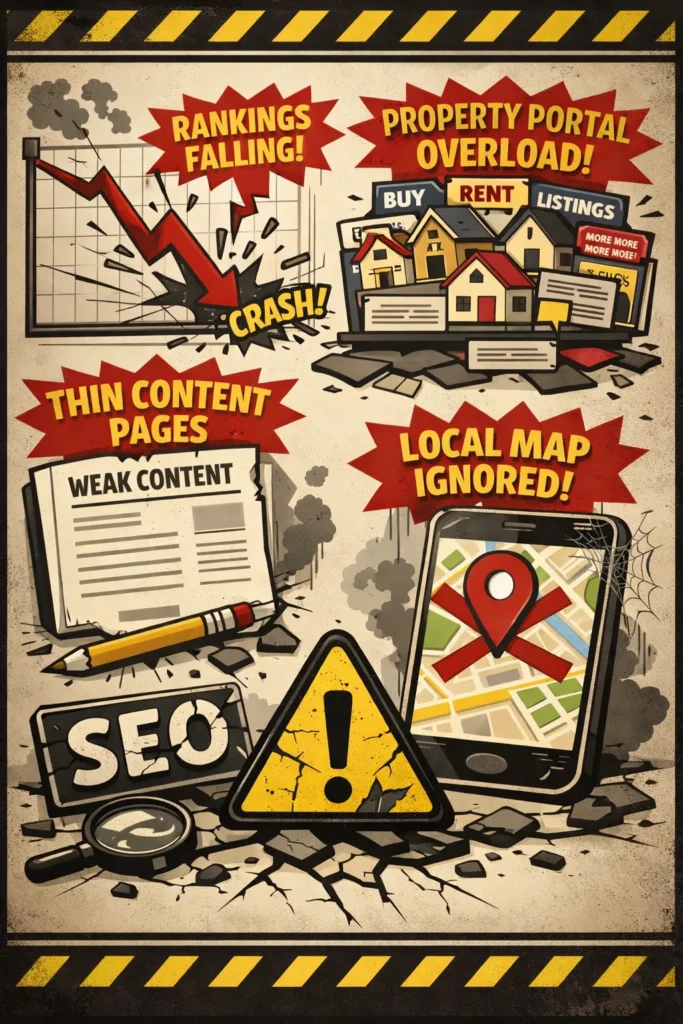
Even the most well-funded real estate marketing campaigns can fail if foundational SEO mistakes are made. In 2026, avoiding these errors is critical for agents, brokers, and developers looking to capture high-intent leads.
Over-Reliance on Portals
Many real estate professionals depend heavily on portals like Bayut, Zameen, and PropertyFinder. While useful for visibility, portals don’t give you ownership of leads or long-term SEO value. Over-dependence can limit brand authority and make your business vulnerable to rising portal fees and algorithm changes.
Ignoring Local SEO
Local SEO is where most high-intent real estate searches happen. Failing to optimize Google Business Profiles, neighborhood pages, and hyper-local keywords means missing out on buyers and investors who search for properties by city, community, or area. Without local optimization, your website won’t appear in map packs or voice-driven searches.
Thin Content
Content that lacks depth or doesn’t address buyer, seller, or investor intent fails to rank and doesn’t convert. Thin content, generic project descriptions, and poorly structured blogs reduce authority, increase bounce rates, and hinder E-E-A-T signals.
No Tracking or Optimization
SEO is iterative. Many agencies and agents fail by not monitoring KPIs, adjusting strategies, or refreshing content. Without tracking traffic, rankings, engagement, and conversions, you cannot identify what works or scale effective strategies across regions.
Avoid these pitfalls by focusing on high-intent, hyper-local content, strong local SEO, continuous optimization, and owning your traffic. Doing so ensures your real estate SEO investment delivers sustainable leads, authority, and ROI in 2026.
FAQs – Real Estate SEO in 2026
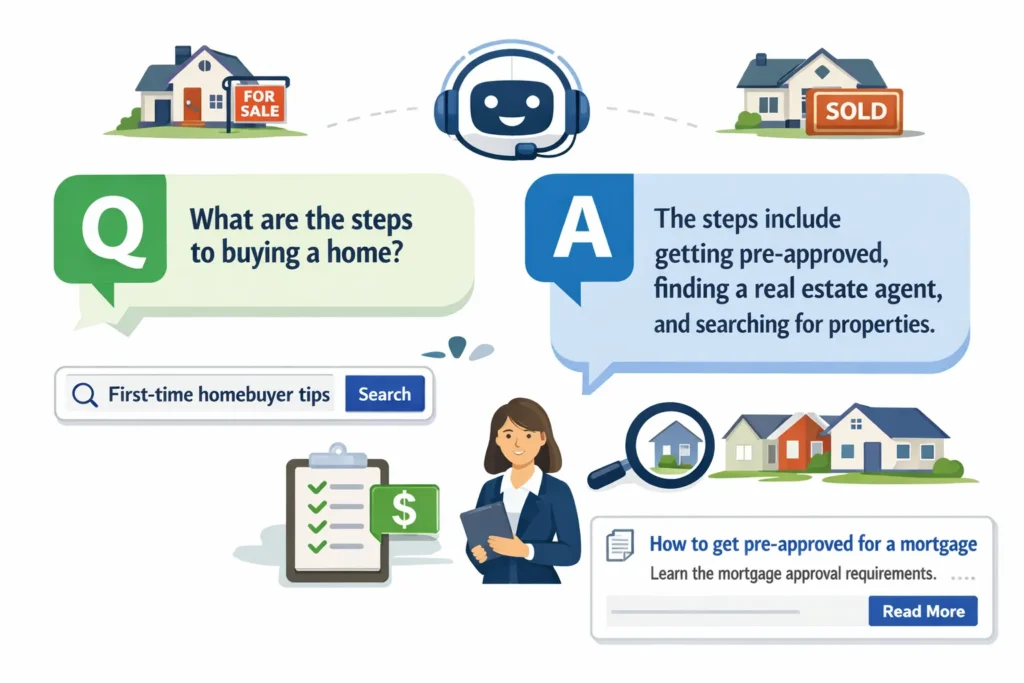
Here are the most common questions real estate agents, brokers, and developers ask about SEO in 2026. Each is optimized for AI answers, featured snippets, and high-intent search queries.
1. What is real estate SEO in 2026?
Real estate SEO in 2026 focuses on Search Everywhere Optimization (SEO + AI + voice + maps), helping agents, brokers, and developers appear in organic search, AI answers, and local packs.
2. Why is local SEO critical for real estate websites?
Local SEO ensures visibility in city, neighborhood, and community searches, Google Maps, and voice queries, attracting high-intent leads in your target regions.
3. How can AI improve real estate lead generation?
AI chatbots qualify leads instantly, provide personalized property recommendations, and integrate with WhatsApp or CRM systems to convert visitors into clients.
4. What are the top keywords for real estate SEO in GCC and Pakistan?
High-intent keywords include hyper-local, transactional, and bilingual queries like “buy apartment in Dubai Marina” or “DHA Phase 6 houses for sale.”
5. How important is content for ranking in 2026?
High-quality, intent-focused content like pillar pages, investment guides, area reviews, and blogs is essential for authority, AI citations, and user trust.
6. What technical SEO aspects should real estate websites prioritize?
Mobile responsiveness, Core Web Vitals, fast site speed, HTTPS, canonical tags, and XML sitemaps are critical for rankings and UX.
7. How long does it take to see results from real estate SEO?
Foundational results appear in 3–6 months, while authority-building and measurable ROI typically take 6–12 months.
8. Should real estate websites target both English and Arabic keywords?
Yes — GCC markets require bilingual strategies, using either bilingual pages or separate URLs based on intent and search behavior.
9. What role do backlinks and PR play in real estate SEO?
High-quality local backlinks, PR mentions, and guest posts build authority, trust, and visibility, especially in competitive regions like UAE and Saudi Arabia.
10. How can agents avoid common SEO mistakes?
Avoid portal over-reliance, thin content, ignoring local SEO, and neglecting performance tracking. Focus on high-intent content, structured internal linking, and continuous optimization.
These FAQs help capture featured snippets, voice search queries, and AI-generated answers, making your real estate website a go-to authority in 2026.
Conclusion – How to Win with Real Estate SEO in 2026

Real estate SEO in 2026 is no longer optional — it’s a strategic growth asset that drives high-intent leads, builds authority, and future-proofs your brand. Across regions like UAE, Saudi Arabia, Pakistan, Qatar, and Bahrain, success comes from combining hyper-local content, AI integration, technical excellence, and E-E-A-T-driven authority.
Key takeaways:
- Focus on high-intent keywords and buyer-specific content
- Optimize for local, mobile, voice, and AI-driven search
- Implement technical SEO and schema markup to enhance visibility
- Build authority through quality backlinks, PR, and social amplification
- Track KPIs, leads, and conversions to measure ROI and refine strategies
SEO is a long-term investment that compounds over time, reducing dependency on portals and paid ads while generating consistent, qualified traffic.
Ready to dominate real estate search in 2026?
- Contact Nexfin Services to discuss your SEO strategy
- Book a strategy call and discover how we can help your agency, brokerage, or development brand capture high-intent leads across your target markets
With the right strategy, tools, and execution, your real estate business can lead, convert, and grow sustainably in the evolving digital landscape.